Back to Materials
Too 100 Java HashMap, ConcurrentHashMap, Hashing & HashSet Interview Q&A Guide
Interview Resource

Too 100 Java HashMap, ConcurrentHashMap, Hashing & HashSet Interview Q&A Guide

₹499.00 ₹600.00
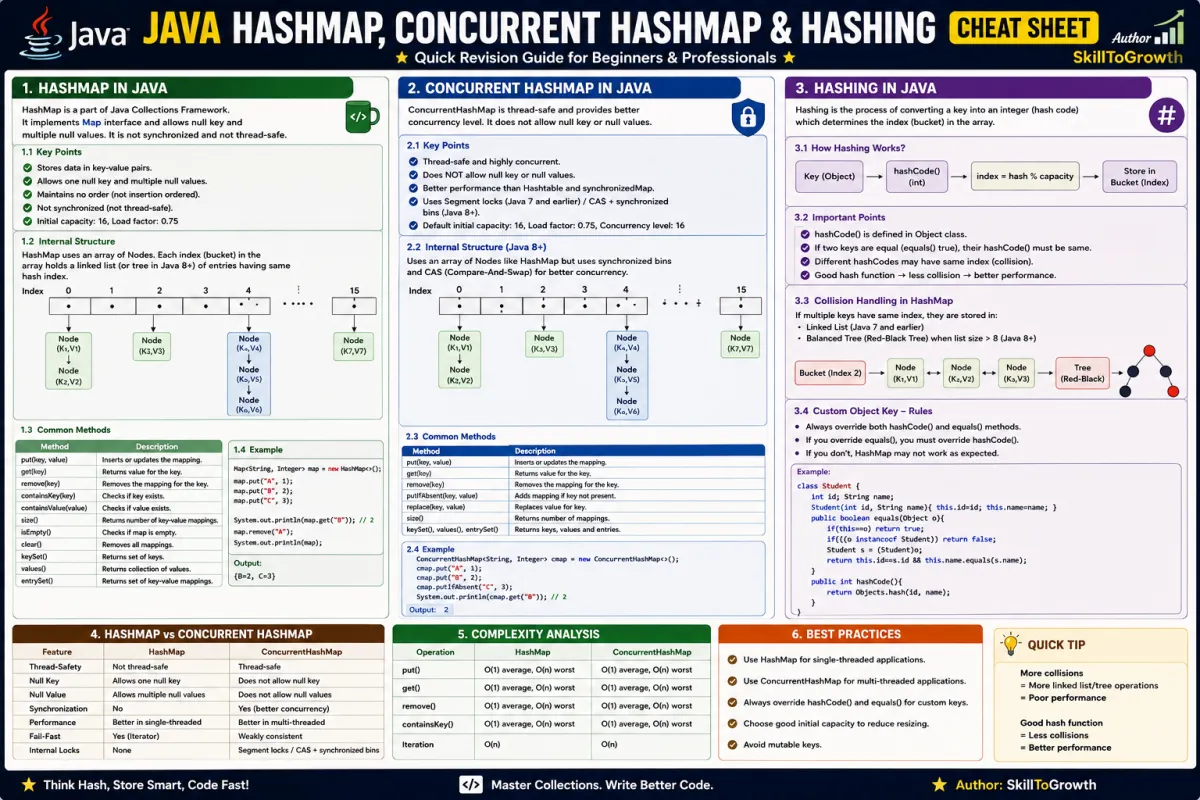
Java Collections play a vital role in almost every Java application, making them one of the most frequently asked topics in technical interviews. Among these, HashMap, ConcurrentHashMap, HashSet, and the concept of Hashing are essential for both freshers and experienced developers. Understanding how these data structures work internally not only helps in interviews but also enables developers to write efficient, scalable, and thread-safe applications.

Hashing is a technique used to convert an object into a unique integer value called a hash code. Java uses this hash code to determine where an object should be stored in memory. The main advantage of hashing is that it allows data retrieval in nearly O(1) time complexity, making it significantly faster than linear searching. Classes such as HashMap and HashSet are built on this hashing mechanism.

A HashMap is one of the most widely used implementations of the Map interface. It stores data in key-value pairs, where each key is unique and maps to a single value. HashMap allows one null key and multiple null values. It does not maintain insertion order or sorting, making it ideal when fast lookup and insertion are more important than ordering. During interviews, candidates are often asked about the internal working of HashMap, including hashing, buckets, collisions, and resizing. Understanding concepts such as equals() and hashCode() methods is also crucial because HashMap relies heavily on these methods to identify keys correctly.

A common interview topic is HashMap collision handling. A collision occurs when two different keys generate the same hash code and are placed in the same bucket. Java handles collisions using Linked Lists, and from Java 8 onwards, if the number of entries in a bucket exceeds a threshold, it converts the linked list into a Red-Black Tree, improving search performance from O(n) to O(log n).

Another important topic is ConcurrentHashMap, which is specifically designed for multi-threaded environments. Unlike HashMap, ConcurrentHashMap is thread-safe and allows multiple threads to read and write simultaneously without locking the entire map. Earlier Java versions used segmented locking, while modern implementations provide finer-grained synchronization, resulting in much better performance. It does not allow null keys or null values because nulls can create ambiguity in concurrent operations. Interviewers frequently ask when to choose ConcurrentHashMap over HashMap or Hashtable and how its synchronization mechanism differs.

A HashSet is another important collection built internally on top of a HashMap. It stores only unique elements and does not allow duplicate values. Since it internally uses hashing, operations such as insertion, deletion, and searching are generally performed in constant time. HashSet does not maintain insertion order, making it suitable for scenarios where uniqueness is the primary requirement. If ordered elements are needed, developers should consider LinkedHashSet or TreeSet.

This interview guide covers frequently asked questions ranging from basic concepts to advanced implementation details. Readers will learn the internal architecture of HashMap, collision resolution techniques, load factor, initial capacity, rehashing, fail-fast iterators, thread safety, ConcurrentHashMap internals, HashSet implementation, performance optimization, coding examples, and real-world interview scenarios. By mastering these topics, developers will gain the confidence to answer Java Collection Framework questions in interviews at service-based companies, product-based companies, and enterprise organizations.

Whether you are a Java Fresher, Software Engineer, Senior Java Developer, or preparing for Spring Boot and Microservices interviews, a solid understanding of HashMap, ConcurrentHashMap, Hashing, and HashSet is an essential step toward cracking Java technical interviews and becoming a proficient Java developer.

Get Instant Access

Secure your copy with India's most trusted payment gateway. Your PDF will be available for download immediately after payment.

100% Secure Instant Download Verified Payment
Login to Purchase

Login to unlock fast, one-click checkout.

Preview

What Our Learners Say

"Clear, concise, and structured. Took my Spring Boot skills from basic to production-ready! — Rohan Gupta, Android & Backend Developer"

- Keep updated knowledge

"The Generative AI course for developers isn't just hype—it teaches practical, hands-on implementation. Integrating LLM APIs into my existing Spring Boot backend went from overwhelming to straightforward. — David Chen | Senior Backend Engineer"

- Game-Changer for Modern Developers

"AI is moving fast, but this site cuts through the noise. The Gen AI modules showed me how to actually build AI-powered features into production applications rather than just prompting existing tools. — Priya Nair | Full-Stack Engineer"

- Keeps You Ahead of the Curve

"Most platforms teach outdated concepts, but the courses here are fresh and directly applicable. Learning how to build clean Mobile Apps alongside solid backend services gave me the confidence to apply for tech roles." — Marcus Vance | Career Transitioner"

- The Best Tech Learning Investment I've Made