Back to Materials
Top 200 RAG, Embeddings, Vector DB, LangChain & LangGraph Interview Question Answer
Interview Resource

Top 200 RAG, Embeddings, Vector DB, LangChain & LangGraph Interview Question Answer

₹899.00 ₹950.00
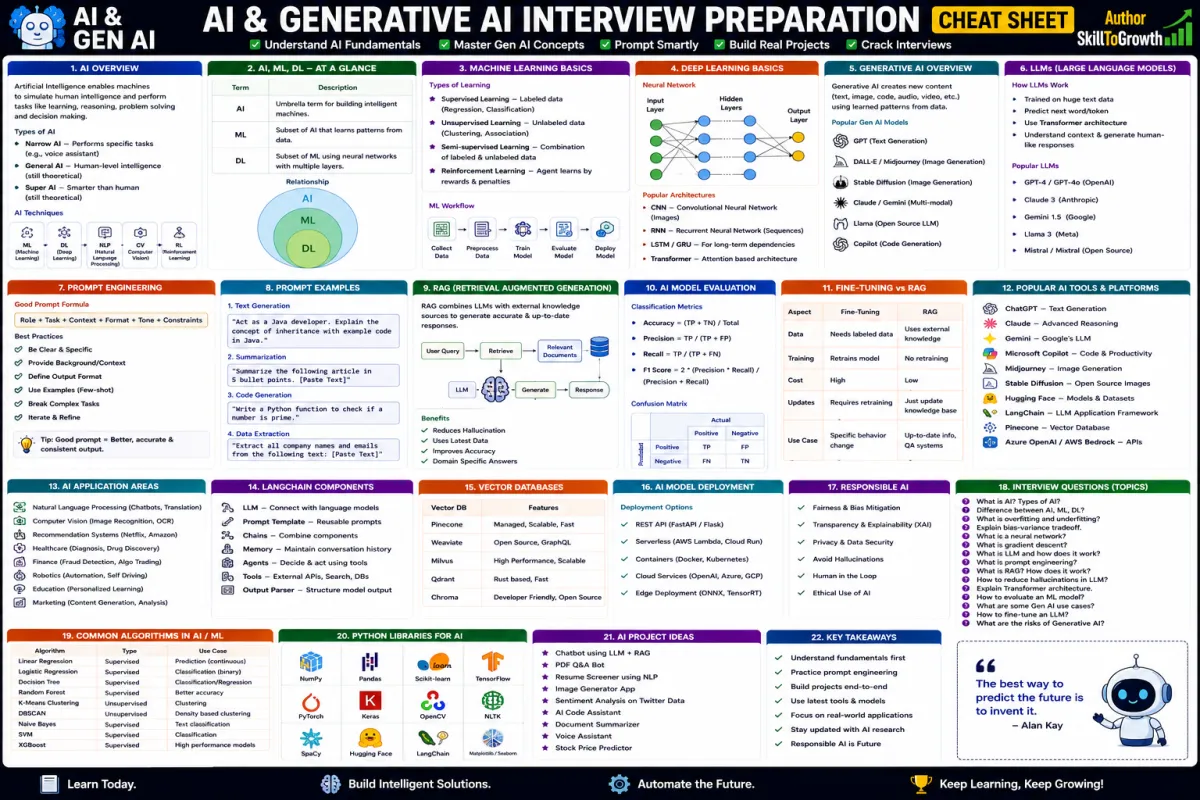
Artificial Intelligence has transformed the way modern applications interact with data, and technologies like Retrieval-Augmented Generation (RAG), Embeddings, Vector Databases, LangChain, and LangGraph have become essential components of AI-powered systems. Today, companies building AI chatbots, enterprise search engines, document assistants, customer support bots, and autonomous AI agents actively look for engineers who understand these concepts. This guide is designed to help students, software developers, backend engineers, and AI enthusiasts prepare for interviews by mastering both theoretical concepts and practical implementations.

One of the most important concepts in modern Generative AI is Retrieval-Augmented Generation (RAG). Instead of relying only on the knowledge stored inside a Large Language Model (LLM), RAG enables AI applications to retrieve relevant information from external data sources before generating a response. This approach significantly improves accuracy, reduces hallucinations, and allows AI systems to answer questions using company-specific documents, PDFs, websites, databases, and knowledge bases. Interviewers frequently ask how RAG works internally, its architecture, advantages over fine-tuning, document chunking strategies, retrieval methods, and techniques for improving retrieval quality.

Another foundational concept is Embeddings. Embeddings convert text, images, or other data into high-dimensional numerical vectors that capture semantic meaning. Unlike keyword-based search, embeddings allow AI systems to understand context and similarity between documents. Two completely different sentences with similar meanings can produce vectors that are close together in vector space. Understanding how embedding models work, cosine similarity, Euclidean distance, vector dimensions, and embedding generation is essential for modern AI engineering interviews.

To efficiently store and search these embeddings, organizations use Vector Databases. Unlike traditional relational databases, vector databases are optimized for similarity search across millions or even billions of vectors. Popular vector databases include Pinecone, Milvus, Qdrant, Weaviate, ChromaDB, and FAISS. Interview questions often focus on indexing algorithms, Approximate Nearest Neighbor (ANN) search, metadata filtering, scalability, hybrid search, and choosing the right vector database for enterprise applications. Understanding how vector databases integrate with RAG pipelines is becoming a highly valued skill in AI backend development.

Modern AI applications also require orchestration frameworks, and LangChain has emerged as one of the most popular libraries for building LLM-powered applications. LangChain simplifies prompt management, document loading, retrieval pipelines, memory management, tool calling, API integration, and chaining multiple AI operations together. Developers use LangChain to build chatbots, AI assistants, question-answering systems, summarization tools, code assistants, and enterprise search platforms. Interviewers frequently ask about Chains, Agents, Retrievers, Memory, Prompt Templates, Output Parsers, Callbacks, and integration with vector databases and LLM providers.

As AI systems become more complex, developers increasingly adopt LangGraph, a framework built for creating stateful, multi-agent, and workflow-driven AI applications. Unlike traditional sequential chains, LangGraph allows developers to model AI workflows as graphs, where each node performs a specific task and edges define execution flow. It supports loops, branching, retries, conditional execution, checkpoints, and persistent state management. LangGraph is widely used for building autonomous AI agents, research assistants, multi-step reasoning systems, and enterprise automation workflows. Understanding graph-based orchestration, state management, agent communication, tool execution, and human-in-the-loop workflows is becoming increasingly important for AI engineering interviews.

This interview guide covers more than just definitions. It explores RAG architecture, document preprocessing, chunking strategies, embedding generation, similarity search algorithms, vector indexing, metadata filtering, LangChain components, LangGraph workflows, multi-agent systems, memory management, performance optimization, production deployment, security considerations, real-world AI architecture, and common interview coding scenarios. It also includes practical examples, best practices, frequently asked interview questions, and architecture discussions used by leading product companies and AI startups.

Whether you are preparing for interviews as an AI Engineer, GenAI Backend Developer, Machine Learning Engineer, LLM Application Developer, Python Developer, Spring AI Developer, or AI Solutions Architect, mastering RAG, Embeddings, Vector Databases, LangChain, and LangGraph will provide a strong foundation for building scalable, intelligent, and production-ready AI applications while significantly improving your chances of succeeding in modern AI technical interviews.

Get Instant Access

Secure your copy with India's most trusted payment gateway. Your PDF will be available for download immediately after payment.

100% Secure Instant Download Verified Payment
Login to Purchase

Login to unlock fast, one-click checkout.

Preview

What Our Learners Say

"Clear, concise, and structured. Took my Spring Boot skills from basic to production-ready! — Rohan Gupta, Android & Backend Developer"

- Keep updated knowledge

"The Generative AI course for developers isn't just hype—it teaches practical, hands-on implementation. Integrating LLM APIs into my existing Spring Boot backend went from overwhelming to straightforward. — David Chen | Senior Backend Engineer"

- Game-Changer for Modern Developers

"AI is moving fast, but this site cuts through the noise. The Gen AI modules showed me how to actually build AI-powered features into production applications rather than just prompting existing tools. — Priya Nair | Full-Stack Engineer"

- Keeps You Ahead of the Curve

"Most platforms teach outdated concepts, but the courses here are fresh and directly applicable. Learning how to build clean Mobile Apps alongside solid backend services gave me the confidence to apply for tech roles." — Marcus Vance | Career Transitioner"

- The Best Tech Learning Investment I've Made