Introduction to REST API: API Fundamentals, REST Principles, Architecture, Client-Server Communication
Introduction to REST API: API Fundamentals, REST Principles, Architecture, Client-Server Communication & REST API Roadmap
SkilltoGrowth Expert
Published on July 28, 2026Modern applications rarely operate in isolation. Mobile apps retrieve user profiles from cloud servers, e-commerce websites process online payments through third-party services, banking applications exchange transaction data with financial systems, and social media platforms communicate with multiple backend services simultaneously. All of these interactions are made possible through Application Programming Interfaces (APIs).
An API acts as a bridge that allows different software systems to communicate securely and efficiently without exposing their internal implementation.
Among the various API architectures available today, REST (Representational State Transfer) has become the most widely adopted standard for building web services due to its simplicity, scalability, flexibility, and compatibility with modern web technologies.
Imagine an online food delivery platform. A customer places an order using a mobile application. The app sends the order details to a backend server, which validates the request, calculates pricing, processes payment, updates the restaurant dashboard, assigns a delivery partner, and returns the order status to the mobile app. All these interactions occur through REST APIs.
Today, REST APIs are the backbone of mobile applications, web platforms, cloud services, microservices, IoT devices, SaaS products, banking systems, healthcare applications, and enterprise software.
In this chapter, you'll learn What an API Is, understand REST, compare REST and SOAP, explore the REST API Architecture, understand Why REST APIs Are Used, learn about Client-Server Architecture, Stateless Communication, Uniform Interface, Resource-Based Design, and follow a structured REST API Learning Roadmap.
Why REST APIs Are Important
Modern software consists of multiple independent applications that must exchange information quickly and securely.
REST APIs enable this communication while keeping systems loosely coupled, scalable, and easy to maintain.
Benefits of REST APIs
🔸 Platform independence
🔸 Easy integration
🔸 Lightweight communication
🔸 High scalability
🔸 Better interoperability
🔸 Cloud compatibility
🔸 Microservices support
🔸 Faster application development
REST APIs have become the standard communication mechanism for modern software systems.
REST API in Modern Architecture
REST APIs connect frontend applications with backend services.
Mobile App
      │
      │
Web Application
      │
      ▼
REST API
      │
      ▼
Business Logic
      │
      ▼
Database
REST APIs act as the communication layer between clients and backend systems.
What is an API?
An Application Programming Interface (API) is a set of rules and standards that allows different software applications to communicate with one another.
Rather than directly accessing another application's internal code or database, software systems exchange requests and responses through APIs.
This abstraction simplifies integration while improving security, flexibility, and maintainability.
APIs are used in nearly every modern application, enabling communication between mobile apps, websites, databases, cloud services, payment gateways, and third-party platforms.
Common Uses of APIs
Examples include:
🔸 Payment processing
🔸 Authentication
🔸 Weather information
🔸 Social media integration
🔸 Maps and location services
🔸 Cloud storage
🔸 Notification services
🔸 Banking transactions
APIs enable seamless communication between independent software systems.
API Communication Flow
A typical API interaction follows this process.
Client
   │
   ▼
API Request
   │
   ▼
Server
   │
   ▼
Business Logic
   │
   ▼
Response
The client sends requests while the server processes them and returns appropriate responses.
What is REST?
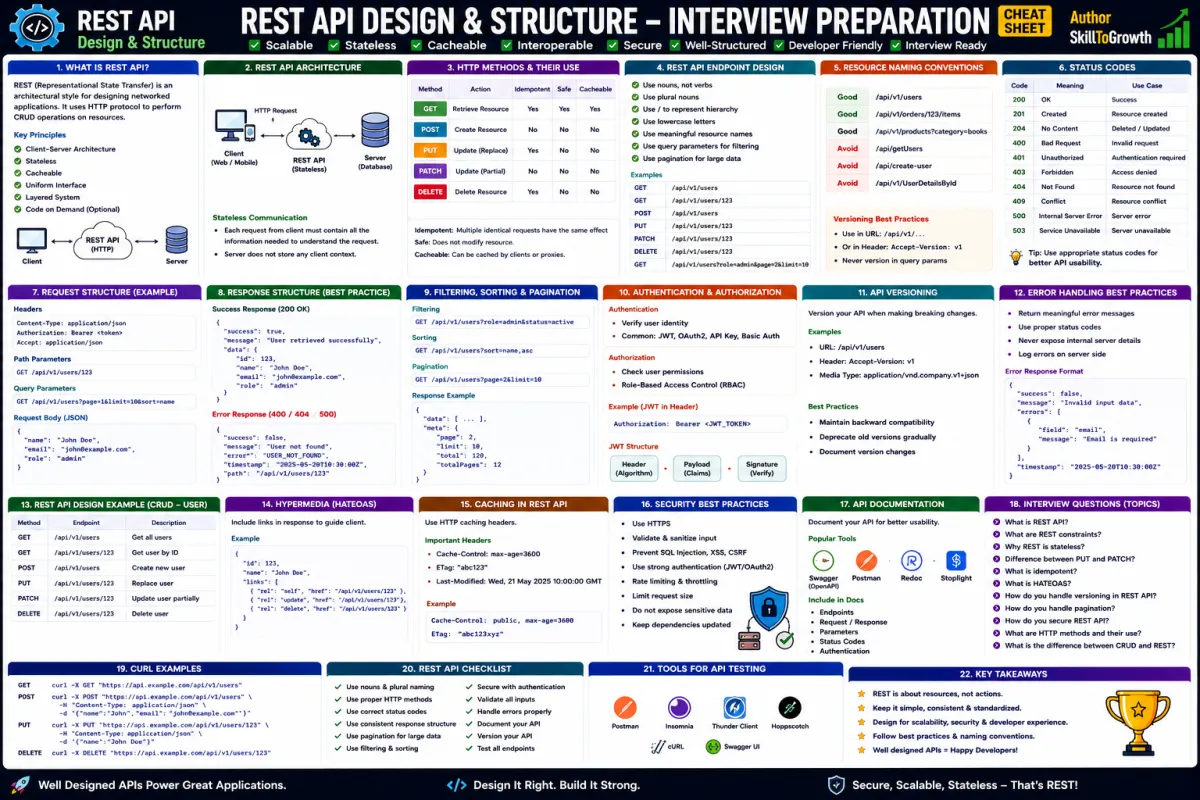
REST (Representational State Transfer) is an architectural style for designing network-based applications.
Rather than defining a strict protocol, REST provides a set of architectural principles that enable scalable, maintainable, and efficient communication between clients and servers.
REST primarily uses standard HTTP methods to perform operations on resources.
Its simplicity and compatibility with web technologies have made it the preferred architecture for modern APIs.
Characteristics of REST
Examples include:
🔸 Client-server architecture
🔸 Stateless communication
🔸 Resource-based design
🔸 Uniform interface
🔸 Cacheable responses
🔸 Layered architecture
🔸 Standard HTTP methods
REST focuses on simplicity, scalability, and interoperability.
REST API Architecture
REST follows a layered architecture where different components perform specialised responsibilities.
The client communicates with the server through HTTP requests, while the server processes business logic and retrieves or updates resources stored in databases.
Each layer remains independent, improving scalability and maintainability.
Major REST Components
Examples include:
🔸 Client
🔸 HTTP Protocol
🔸 REST API
🔸 Business Logic
🔸 Database
🔸 Response
Each component contributes to reliable communication between applications.
REST Architecture Workflow
Professional REST applications generally follow this architecture.
Client
   │
   ▼
HTTP Request
   │
   ▼
REST API
   │
   ▼
Business Layer
   │
   ▼
Database
   │
   ▼
HTTP Response
This layered architecture separates presentation, business logic, and data storage.
REST vs SOAP
REST and SOAP are two widely recognised approaches for building web services.
Although both enable communication between systems, they differ significantly in architecture, flexibility, and complexity.
| Feature | REST | SOAP |
|---|---|---|
| Architecture | Architectural Style | Protocol |
| Communication Format | JSON, XML, Text | XML Only |
| Performance | Faster | Slower |
| Complexity | Simple | Complex |
| Learning Curve | Easy | Moderate |
| Scalability | Excellent | Good |
| Mobile Friendly | Yes | Limited |
| Enterprise Integration | Excellent | Strong |
Today, REST is preferred for most modern web and mobile applications, while SOAP remains common in some enterprise systems requiring strict standards.
Why Use REST APIs?
REST APIs have become the industry standard because they are simple, lightweight, and scalable.
Their flexibility allows applications written in different programming languages to communicate using standard HTTP protocols.
Advantages of REST
Examples include:
🔸 Platform independent
🔸 Lightweight messages
🔸 Easy integration
🔸 High performance
🔸 Better scalability
🔸 Language independent
🔸 Cloud compatibility
🔸 Microservices friendly
REST simplifies communication across distributed systems.
Client-Server Architecture
One of the core principles of REST is the separation of client and server responsibilities.
The client handles user interaction, while the server manages business logic, authentication, data processing, and persistence.
This separation enables both systems to evolve independently.
Client Responsibilities
Examples include:
🔸 User interface
🔸 User interaction
🔸 Request generation
🔸 Response presentation
Server Responsibilities
Examples include:
🔸 Business logic
🔸 Authentication
🔸 Validation
🔸 Database operations
🔸 Response generation
This separation improves scalability and maintainability.
Client-Server Communication
Client
   │
HTTP Request
   │
   ▼
REST Server
   │
Business Processing
   │
   ▼
HTTP Response
The client never directly accesses the database or server implementation.
Stateless Communication
REST APIs are stateless, meaning each request contains all information required for processing.
The server does not store client session information between requests.
Each request remains independent from previous interactions.
This architecture improves scalability because servers do not need to maintain client-specific session data.
Benefits of Stateless Communication
Examples include:
🔸 Better scalability
🔸 Simplified server design
🔸 Easier load balancing
🔸 Improved reliability
🔸 Independent requests
Stateless communication enables highly scalable distributed systems.
Uniform Interface
The Uniform Interface principle ensures consistent communication between clients and servers.
Regardless of the resource being accessed, APIs follow common conventions for resource identification, request methods, and response formats.
Consistency simplifies API development and integration.
Uniform Interface Principles
Examples include:
🔸 Consistent resource naming
🔸 Standard HTTP methods
🔸 Self-descriptive messages
🔸 Predictable responses
🔸 Uniform resource identification
These principles improve developer experience and API usability.
Resource-Based Design
REST APIs treat every piece of information as a resource.
Resources represent entities such as users, products, orders, customers, employees, invoices, or payments.
Each resource is uniquely identified and manipulated through standard HTTP operations.
Resource-based design creates intuitive and maintainable APIs.
Common REST Resources
Examples include:
🔸 Users
🔸 Products
🔸 Orders
🔸 Customers
🔸 Payments
🔸 Categories
🔸 Employees
🔸 Reviews
Every REST endpoint typically represents a resource rather than an action.
REST API Design Workflow
A well-designed REST API generally follows this process.
Identify Resources
        │
        ▼
Design Endpoints
        │
        ▼
Apply HTTP Methods
        │
        ▼
Validate Requests
        │
        ▼
Return Responses
Resource-oriented design produces clean, scalable APIs.
REST API Learning Roadmap
Learning REST APIs becomes easier through a structured progression.
A recommended roadmap includes:
🔸 HTTP Fundamentals
🔸 REST Principles
🔸 API Design
🔸 Resources
🔸 Endpoints
🔸 Request & Response
🔸 Status Codes
🔸 Authentication
🔸 Validation
🔸 Documentation
🔸 Testing
🔸 API Security
🔸 Versioning
🔸 Deployment
Following this roadmap builds a strong foundation for backend and full-stack development.
Comparison of REST API Concepts
Each REST concept serves a distinct purpose.
| Concept | Primary Purpose |
| API | Software communication |
| REST | API architectural style |
| Client | Sends requests |
| Server | Processes requests |
| Resource | Business entity |
| Endpoint | Resource access URL |
| HTTP | Communication protocol |
| Response | Returns requested data |
Together, these concepts define modern RESTful services.
Benefits of REST Architecture
Professional organisations adopt REST because of numerous advantages.
Key Benefits
🔸 Simplicity
🔸 Scalability
🔸 High performance
🔸 Platform independence
🔸 Better interoperability
🔸 Easy maintenance
🔸 Cloud readiness
🔸 Microservices compatibility
REST has become the foundation of modern distributed applications.
Best Practices for REST APIs
Professional API developers follow consistent design principles.
Recommended Practices
🔸 Design resource-oriented APIs
🔸 Maintain stateless communication
🔸 Use consistent endpoint naming
🔸 Follow HTTP standards
🔸 Keep responses predictable
🔸 Validate client requests
🔸 Document APIs thoroughly
🔸 Apply authentication and authorisation
🔸 Version APIs carefully
🔸 Design for scalability
Following these practices produces reliable, maintainable APIs.
Common Mistakes Beginners Make
Many developers encounter similar challenges while learning REST.
Common Mistakes
🔸 Confusing REST with HTTP
🔸 Designing action-based endpoints
🔸 Ignoring stateless principles
🔸 Using inconsistent resource names
🔸 Poor response structure
🔸 Weak API documentation
🔸 Inconsistent endpoint design
🔸 Neglecting security considerations
Avoiding these mistakes results in cleaner and more maintainable APIs.
Chapter Summary
In this chapter, you explored the fundamentals of REST APIs and their role in modern software development. You learned What an API Is, understood REST, compared REST and SOAP, explored the REST API Architecture, understood Why REST APIs Are Used, learned about Client-Server Architecture, Stateless Communication, Uniform Interface, Resource-Based Design, and followed a structured REST API Learning Roadmap. Together, these concepts provide the foundation for designing scalable, maintainable, and interoperable web services.
REST API Interview Questions
REST API fundamentals are frequently discussed in Backend, Java, Spring Boot, Node.js, .NET, Python, Cloud, and Full-Stack interviews.
Frequently Asked Questions
🔸 What is an API?
🔸 What is REST?
🔸 Explain REST architecture.
🔸 What is the difference between REST and SOAP?
🔸 Why are REST APIs stateless?
🔸 What is Client-Server Architecture?
🔸 What is Uniform Interface?
🔸 What is Resource-Based Design?
🔸 Why are REST APIs preferred in modern applications?
🔸 What are the best practices for designing REST APIs?
Being able to explain these concepts demonstrates a solid understanding of RESTful architecture and modern web service design.
Real-World Enterprise Scenario
Imagine a multinational e-commerce company operating web, mobile, and partner applications. Customers browse products using a React-based website, while delivery personnel use an Android application and warehouse staff manage inventory through an internal dashboard. All these systems communicate with the same backend through REST APIs. Each client sends HTTP requests to retrieve products, create orders, update delivery status, or process payments. The REST API validates requests, executes business logic, interacts with databases, and returns structured responses. Because the API follows stateless communication, resource-based design, and a uniform interface, the organisation can independently scale frontend applications, backend services, and databases while supporting millions of daily transactions reliably.