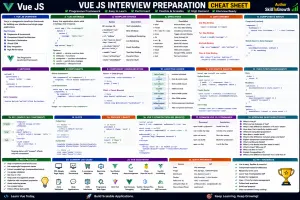
JavaScript Essentials for Vue.js: Mastering Modern JavaScript (ES6+) Before Learning Vue
JavaScript Essentials for Vue.js: Mastering Modern JavaScript (ES6+) Before Learning Vue
SkilltoGrowth Expert
Published on July 31, 2026Before diving deep into Vue.js, it's important to build a strong foundation in modern JavaScript. Although Vue simplifies frontend development with its reactive system and component-based architecture, it is still a JavaScript framework at its core. Every Vue component, method, event, lifecycle hook, and API interaction relies on JavaScript concepts.
Many beginners jump directly into learning Vue without understanding JavaScript fundamentals. As a result, they often struggle with concepts like reactive data, computed properties, asynchronous programming, component communication, and state management. The issue usually isn't Vue itself—it's a lack of familiarity with modern JavaScript.
Over the years, JavaScript has evolved significantly. Features introduced in ECMAScript 6 (ES6) and later versions have transformed how developers write applications. Modern syntax is cleaner, more expressive, and easier to maintain than traditional JavaScript. Frameworks like Vue 3, React, Angular, Node.js, and many modern libraries heavily rely on these newer language features.
Imagine building an e-commerce application using Vue.js. Product data is fetched from an API, displayed in reusable components, filtered based on user preferences, and updated dynamically without reloading the page. Behind the scenes, JavaScript powers every interaction—from making asynchronous API calls to updating reactive data and rendering the user interface.
This chapter introduces the essential JavaScript concepts every Vue developer should master before building real-world applications. Understanding these topics will not only make learning Vue easier but will also improve your confidence as a frontend developer.
Why JavaScript Knowledge Matters Before Learning Vue
Vue is designed to simplify frontend development, but it does not replace JavaScript. Instead, it builds upon it.
A developer who understands modern JavaScript can quickly learn Vue concepts such as components, reactive state, routing, API integration, and state management.
Strong JavaScript knowledge also improves debugging skills, code readability, and overall development efficiency.
Learning JavaScript first provides several advantages:
- Faster understanding of Vue syntax
- Better problem-solving skills
- Easier debugging
- Cleaner application architecture
- Better performance optimisation
- Improved interview preparation
- Greater flexibility to learn React, Angular, or Node.js later
Rather than memorising Vue syntax, you'll understand why the framework behaves the way it does.
Understanding ES6+ Features
ECMAScript 6, commonly known as ES6, introduced many powerful features that made JavaScript cleaner and more developer-friendly. Since its release, additional versions of JavaScript have continued to improve the language with new syntax and capabilities.
Modern frontend development almost always uses ES6+ syntax because it reduces boilerplate code and improves readability.
Some of the most widely used ES6+ features include:
- Block-scoped variables
- Arrow functions
- Template literals
- Object destructuring
- Spread operators
- Modules
- Promises
- Async programming
- Optional chaining
Understanding these features makes reading Vue documentation and production code much easier.
let vs const
Before ES6, JavaScript primarily used the var keyword for variable declaration. While functional, it often created confusion because of function scope and variable hoisting.
Modern JavaScript introduces let and const, which provide block-level scope and make code easier to understand.
The let keyword is used for variables whose values may change during execution.
The const keyword is used for values that should remain constant after initialization.
Using const wherever possible is considered a best practice because it prevents accidental reassignment and makes the developer's intent clearer.
In Vue applications, you'll frequently see const used for component configuration, imported modules, and references that never change, while let is used when variable values are expected to change.
Arrow Functions
Arrow functions provide a shorter and cleaner way to write JavaScript functions.
Beyond reducing syntax, they also handle the this keyword differently, making them especially useful in callbacks and asynchronous operations.
Vue applications frequently use arrow functions while processing arrays, handling promises, filtering data, mapping collections, and working with asynchronous API responses.
Compared to traditional functions, arrow functions produce cleaner and more readable code, particularly when working with modern JavaScript frameworks.
Understanding when to use arrow functions—and when traditional functions remain appropriate—is an important skill for every Vue developer.
Template Literals
Template literals simplify string creation by allowing developers to embed variables and expressions directly inside strings.
Instead of combining multiple strings using concatenation, template literals create cleaner and more readable code.
Vue templates frequently display dynamic information such as usernames, product names, prices, dates, and calculated values. Understanding template literals makes generating these strings much easier.
They also support multi-line strings, improving readability for longer text content.
Destructuring
Destructuring allows developers to extract values from objects and arrays into individual variables.
Instead of repeatedly accessing object properties, destructuring creates cleaner and shorter code.
Vue developers commonly use destructuring when working with:
- Component properties
- API responses
- Function parameters
- State management
- Configuration objects
Large applications often retrieve complex JSON responses from backend APIs. Destructuring simplifies accessing deeply nested information while improving readability.
Spread and Rest Operators
The spread and rest operators share the same syntax but serve different purposes.
The spread operator expands arrays or objects into individual elements.
It is commonly used for:
- Copying arrays
- Copying objects
- Merging data
- Passing multiple values to functions
The rest operator collects multiple values into a single array or object.
It is especially useful when functions accept a variable number of parameters.
Vue applications frequently use spread operators while updating reactive state without directly modifying existing objects.
These operators encourage immutable programming practices, reducing unexpected side effects.
Modules (Import and Export)
Modern JavaScript encourages modular development.
Instead of writing an entire application inside one large file, developers divide code into smaller reusable modules.
Each module focuses on a single responsibility.
Modules improve:
- Code organisation
- Reusability
- Maintainability
- Team collaboration
- Application scalability
Vue applications heavily depend on modules.
Components, services, utilities, API clients, composables, stores, and configuration files are all organised into separate modules that communicate using import and export statements.
Without modules, maintaining large applications would quickly become difficult.
Promises
Many operations in web development require waiting for external resources.
Examples include:
- Calling REST APIs
- Uploading files
- Reading data from servers
- Authentication
- Database communication
Since these operations take time, JavaScript uses asynchronous programming.
Promises provide a structured way to handle operations that complete sometime in the future.
Instead of blocking application execution, JavaScript continues running while waiting for the operation to finish.
Once completed, the Promise either returns a successful result or reports an error.
Promises greatly improve application responsiveness and user experience.
Async and Await
Although Promises simplified asynchronous programming, chaining multiple promises often resulted in complex code.
The introduction of async and await made asynchronous programming much easier to read and understand.
With async/await, asynchronous code resembles normal sequential code while remaining non-blocking.
Vue developers frequently use async/await when:
- Fetching API data
- Loading user profiles
- Uploading files
- Authenticating users
- Retrieving dashboard information
Because async/await improves readability, it has become the preferred approach for handling asynchronous operations in modern JavaScript applications.
Optional Chaining
Applications frequently work with data received from external APIs.
Sometimes expected properties may be missing or contain null values.
Accessing unavailable properties traditionally caused runtime errors.
Optional chaining solves this problem by allowing developers to safely access nested properties without manually checking every level.
This feature greatly simplifies handling incomplete or optional data.
Vue applications commonly consume third-party APIs where certain fields may not always exist.
Optional chaining reduces defensive code while improving readability.
Closures
Closures are one of JavaScript's most powerful concepts.
A closure occurs when a function remembers variables from its surrounding scope even after that outer function has finished executing.
Although beginners often find closures difficult to understand initially, they are used extensively throughout modern JavaScript.
Closures make possible many advanced programming techniques, including:
- Data encapsulation
- Function factories
- Event handlers
- Callbacks
- Module patterns
- State preservation
Many Vue internals, JavaScript libraries, and framework utilities rely on closures to manage application state and private variables efficiently.
Understanding closures significantly improves a developer's overall JavaScript knowledge.
Modern JavaScript Best Practices
Writing functional JavaScript is only part of becoming a professional developer. Writing maintainable, scalable, and readable JavaScript is equally important.
Professional teams follow established coding practices to ensure projects remain easy to maintain as they grow.
Some recommended best practices include:
- Prefer const whenever values do not change.
- Use let instead of var.
- Write meaningful variable and function names.
- Keep functions small and focused.
- Break applications into reusable modules.
- Use async/await for asynchronous operations.
- Avoid deeply nested logic whenever possible.
- Handle errors gracefully.
- Follow consistent formatting and naming conventions.
- Write code that is easy for others to understand.
Following these practices improves collaboration and long-term maintainability.
Common Mistakes
Developers beginning their JavaScript journey often encounter similar challenges.
Some common mistakes include:
- Continuing to use var instead of let or const.
- Overusing global variables.
- Misunderstanding the this keyword.
- Ignoring asynchronous behaviour.
- Creating large functions with multiple responsibilities.
- Modifying objects directly instead of creating copies.
- Forgetting to handle Promise errors.
- Writing inconsistent module structures.
- Confusing null and undefined values.
- Avoiding modern ES6+ syntax.
Recognising these mistakes early helps developers build cleaner and more reliable applications.
Chapter Summary
Modern JavaScript forms the foundation of every Vue.js application. Features introduced through ES6 and later versions have transformed the language into a cleaner, more expressive, and developer-friendly platform for building web applications. Concepts such as let, const, arrow functions, template literals, destructuring, spread operators, modules, Promises, async/await, optional chaining, and closures are used throughout Vue development. Mastering these concepts before learning Vue makes component development, API integration, state management, and application architecture significantly easier while improving overall programming confidence.
Interview Questions
- What is ECMAScript (ES6), and why is it important?
- Explain the difference between let, const, and var.
- What are the advantages of arrow functions?
- What are template literals, and when should they be used?
- Explain object and array destructuring with practical use cases.
- What is the difference between the spread operator and the rest operator?
- Why are JavaScript modules important in large applications?
- What is a Promise, and why is it used?
- Explain the difference between Promises and async/await.
- What are closures, and where are they commonly used?