REST Principles: Understanding Client-Server Architecture, Statelessness, Cacheability, Layered System, Uniform Interface & REST Constraints
REST Principles: Understanding Client-Server Architecture, Statelessness, Cacheability, Layered System, Uniform Interface & REST Constraints
SkilltoGrowth Expert
Published on July 28, 2026REST (Representational State Transfer) has become the most widely adopted architectural style for designing web services and APIs. From social media platforms and e-commerce websites to banking systems and cloud applications, REST powers millions of interactions every second. Although developers frequently use the term "REST API," many focus only on creating endpoints without understanding the principles that make an API truly RESTful.
REST is not a protocol, programming language, or framework. Instead, it is a set of architectural principles introduced by Roy Fielding in his doctoral dissertation in 2000. These principles provide guidelines for designing scalable, maintainable, and loosely coupled distributed systems. When followed correctly, they allow applications developed using different technologies and deployed on different platforms to communicate efficiently.
Modern frameworks such as Spring Boot, ASP.NET Core, Express.js, Django, Laravel, and Node.js make it easy to create REST APIs. However, simply exposing HTTP endpoints does not automatically make an API RESTful. The quality of an API depends on how well it follows REST principles and constraints.
Understanding REST principles is essential because they influence API performance, scalability, maintainability, caching, security, and client-server communication. They also form the foundation of modern cloud-native applications, microservices, and Software-as-a-Service (SaaS) platforms.
In this chapter, you'll explore the core principles of REST architecture, understand why they exist, and learn how they help developers build reliable and scalable web services.
Why REST Principles Matter
As applications grow larger, they become more difficult to maintain. Thousands of users may access the same application simultaneously from web browsers, mobile devices, desktop applications, smart TVs, or IoT devices. Without a well-defined architecture, managing communication between these clients and backend services quickly becomes complex.
REST principles solve many of these challenges by encouraging a standard approach to API design.
Following REST principles helps developers:
- Build scalable applications
- Improve API consistency
- Reduce coupling between clients and servers
- Increase system flexibility
- Simplify maintenance
- Improve caching and performance
- Support multiple client platforms
- Enable easier integration with third-party systems
These advantages explain why REST has become the preferred architectural style for modern web development.
Client-Server Architecture
One of the most fundamental REST principles is the separation of responsibilities between the client and the server.
The client is responsible for presenting information to users and collecting user input. This could be a web browser, Android application, Flutter app, desktop software, or another service.
The server is responsible for processing requests, applying business logic, interacting with databases, and returning appropriate responses.
This clear separation allows both components to evolve independently. For example, a company may redesign its mobile application without changing the backend API. Likewise, the backend team can optimise database queries or migrate to cloud infrastructure without requiring changes to the client application, provided the API contract remains the same.
This separation offers several important benefits. Frontend and backend teams can work independently, different clients can reuse the same API, and backend services remain reusable across multiple platforms. An online shopping platform, for instance, can expose the same REST API to its website, Android app, iOS app, and partner applications without duplicating business logic.
By separating presentation from business logic, applications become easier to maintain, extend, and scale.
Statelessness
Statelessness is one of the defining characteristics of REST architecture.
A stateless server does not remember previous client requests. Every incoming request must contain all the information required to process it successfully.
Suppose a user logs into an online banking application and requests their account details. The authentication information must accompany every protected request, allowing the server to verify the user's identity each time. The server does not rely on memory from earlier interactions.
This approach offers several advantages. Since requests are independent, any available server can process them, making it easy to distribute traffic across multiple servers using load balancers. If one server becomes unavailable, another can continue handling requests without interruption.
Stateless communication also simplifies scaling because servers do not need to synchronise session information. This is one of the key reasons why REST APIs are widely used in cloud-native applications and microservices.
Although every request may contain repeated authentication information, the benefits of scalability, reliability, and fault tolerance far outweigh the additional overhead.
Cacheability
REST encourages responses to be cacheable whenever appropriate.
Caching allows clients, browsers, proxy servers, or Content Delivery Networks (CDNs) to store frequently requested responses temporarily. When the same resource is requested again, the cached version can be returned without contacting the server.
Imagine visiting an online news website. The company logo, style sheets, JavaScript files, and other static resources rarely change. Instead of downloading them every time a page loads, browsers retrieve these resources from local cache, resulting in significantly faster page loading.
REST APIs can also cache responses for resources that change infrequently, such as product categories, country lists, public weather information, or application settings.
Effective caching reduces server workload, decreases network traffic, improves application performance, and provides a better user experience.
However, developers must ensure that cached data remains valid. Returning outdated information can create inconsistencies and reduce user trust.
Layered System
REST architecture follows a layered system design.
Clients do not need to know whether they are communicating directly with the main server or through intermediate components. Requests may pass through several layers before reaching the final application.
These layers can include:
- Load balancers
- API gateways
- Authentication servers
- Firewalls
- Reverse proxies
- Cache servers
- Microservices
Each layer performs a specific responsibility without exposing its internal implementation to the client.
For example, when a mobile application requests customer information, the request may first pass through an API Gateway for authentication, then through a load balancer, followed by several backend microservices before reaching the database. Despite these intermediate components, the client experiences a single, consistent API.
This layered architecture improves scalability, security, maintainability, and system flexibility while allowing infrastructure changes without affecting client applications.
Uniform Interface
The Uniform Interface is often considered the most important principle of REST.
It ensures that APIs follow consistent rules, making them easier to understand and consume regardless of who developed them.
A uniform interface encourages developers to identify resources using URLs, manipulate those resources using standard HTTP methods, exchange representations such as JSON or XML, and communicate using predictable request and response formats.
For example, if an API uses GET to retrieve customer information, developers naturally expect POST to create customers, PUT or PATCH to update them, and DELETE to remove them. Following these conventions reduces confusion and improves developer productivity.
Consistency is particularly valuable in enterprise environments where multiple development teams work on hundreds of APIs. A uniform interface ensures that developers can quickly understand and integrate with unfamiliar services without extensive documentation.
Code on Demand
Code on Demand is the only optional REST constraint.
It allows servers to extend client functionality by sending executable code when necessary.
Historically, web servers used this principle to send JavaScript files that browsers executed locally. Instead of embedding all application behaviour within static HTML pages, browsers could download additional scripts to perform validation, update interfaces dynamically, or provide interactive features.
Although modern REST APIs rarely rely on Code on Demand, the concept remains relevant in web applications where JavaScript, WebAssembly, or other executable resources are delivered to clients.
Because it is optional, many REST APIs fully comply with REST architecture without implementing this constraint.
Richardson Maturity Model
The Richardson Maturity Model is a useful framework for evaluating how closely an API follows REST principles.
It consists of four maturity levels.
Level 0 – The Swamp of POX
At this level, applications expose a single endpoint and use HTTP merely as a transport mechanism. REST principles are largely ignored.
Level 1 – Resources
The API begins identifying resources using meaningful URLs, making endpoints more organised and understandable.
Level 2 – HTTP Verbs
Standard HTTP methods such as GET, POST, PUT, PATCH, and DELETE are used correctly to perform operations on resources. Most modern REST APIs operate at this level.
Level 3 – Hypermedia (HATEOAS)
The highest maturity level introduces Hypermedia as the Engine of Application State (HATEOAS). Responses include links that guide clients toward available actions, allowing applications to discover functionality dynamically instead of relying entirely on external documentation.
Although relatively few public APIs fully implement Level 3, the Richardson Maturity Model remains an excellent reference for improving REST API design.
REST Constraints
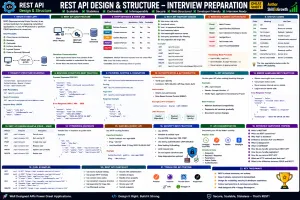
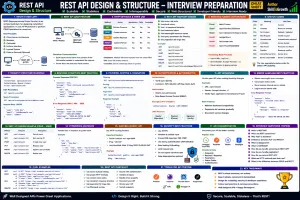
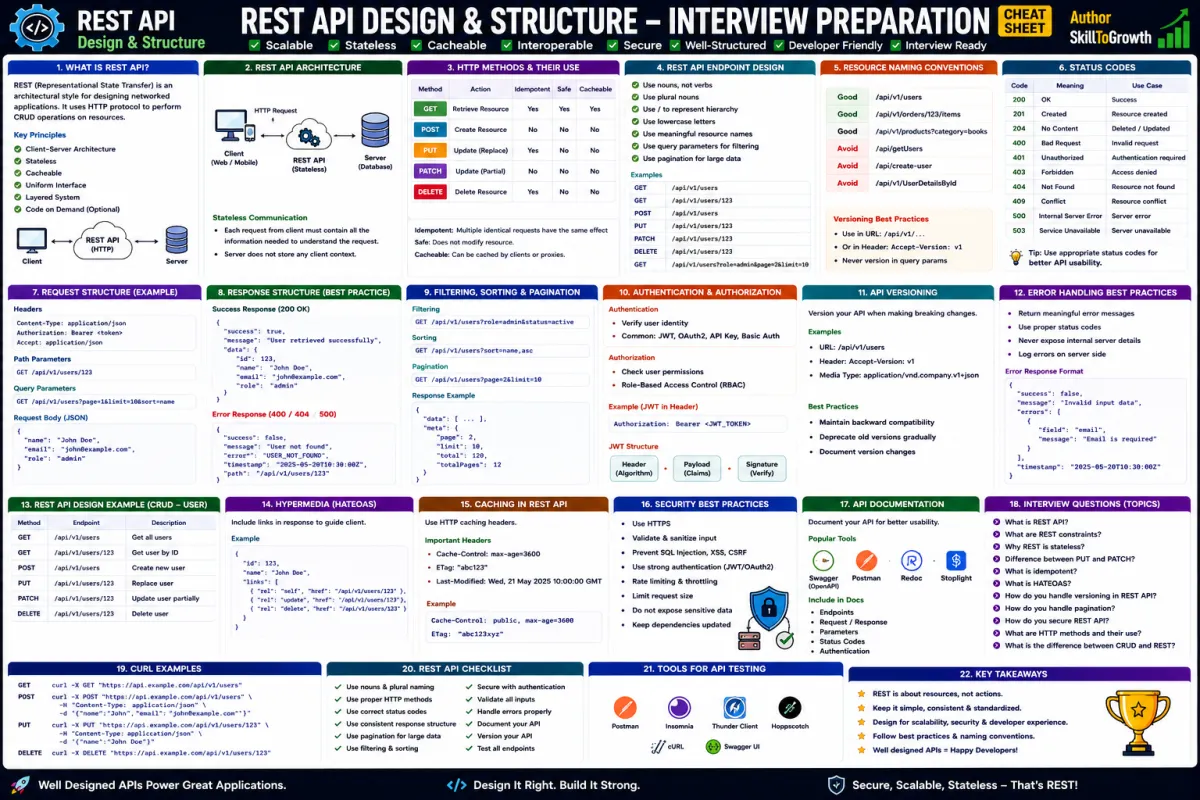
REST architecture is built upon six constraints that define how distributed systems should operate.
These constraints include:
- Client-Server
- Statelessness
- Cacheability
- Uniform Interface
- Layered System
- Code on Demand (Optional)
Together, these principles create systems that are scalable, loosely coupled, maintainable, and capable of evolving over time.
Ignoring one or more constraints may still produce functional APIs, but they may no longer exhibit the characteristics that make REST architecture effective.
REST Best Practices
Designing a REST API involves more than exposing endpoints. Following established best practices results in APIs that are easier to understand, maintain, and integrate.
Some recommended practices include:
- Use meaningful resource-oriented URLs.
- Follow standard HTTP methods consistently.
- Return appropriate HTTP status codes.
- Keep APIs stateless.
- Design predictable request and response structures.
- Use JSON as the default response format whenever possible.
- Version APIs to support future changes.
- Secure endpoints using HTTPS and proper authentication.
- Apply caching where appropriate to improve performance.
- Write clear API documentation for developers.
Following these practices improves the developer experience while ensuring long-term maintainability.
Common Mistakes
Many developers unintentionally violate REST principles while building APIs.
Some common mistakes include:
- Using verbs instead of resources in URLs.
- Performing updates with GET requests.
- Returning incorrect HTTP status codes.
- Storing unnecessary client state on the server.
- Ignoring caching opportunities.
- Creating inconsistent endpoint naming conventions.
- Designing APIs without proper versioning.
- Mixing business logic with presentation concerns.
Avoiding these mistakes results in APIs that are more reliable, scalable, and easier to consume.
Chapter Summary
REST principles provide the architectural foundation for designing scalable and maintainable web services. By separating client and server responsibilities, embracing stateless communication, supporting caching, organising systems into layers, and maintaining a uniform interface, REST enables applications to communicate efficiently across diverse platforms. The optional Code on Demand constraint and the Richardson Maturity Model further illustrate how REST architecture can evolve to support increasingly sophisticated APIs. Understanding these principles allows developers to build web services that are flexible, reusable, secure, and capable of supporting modern distributed applications.
Interview Questions
- What is REST, and why is it widely used in modern application development?
- Explain the Client-Server principle in REST architecture.
- What does stateless communication mean, and why is it important?
- How does caching improve REST API performance?
- Explain the Layered System constraint with an example.
- Why is the Uniform Interface considered the core principle of REST?
- What is Code on Demand, and why is it optional?
- What is the Richardson Maturity Model?
- List and explain the REST architectural constraints.
- What are some best practices for designing RESTful APIs?