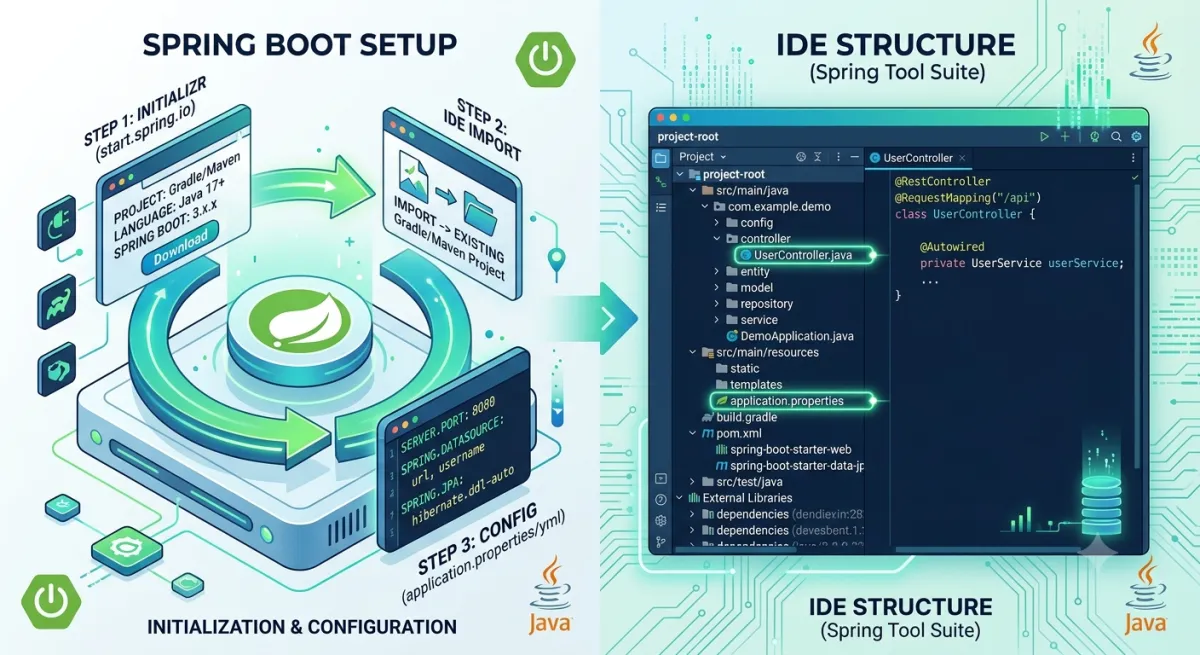
Introduction to Spring Boot REST API: Complete Guide to Spring Boot Basics, REST APIs, Architecture & Real-World Applications
Spring Boot Basics
SkilltoGrowth Expert
Published on March 20, 2026Modern applications rarely work in isolation. Whether you're using a mobile app, a web application, or even a smart TV, it constantly communicates with a backend server to retrieve and update data. When you log in to an application, browse products, book a hotel, order food, or make an online payment, your device is communicating with a REST API running on a backend server.
For example, consider an e-commerce application. The Android or React Native app doesn't store thousands of products locally. Instead, it sends a request to a backend server asking for product information. The server processes the request, retrieves data from a database, and sends a structured response back to the application. This communication happens through REST APIs.
One of the most popular technologies for building REST APIs in Java is Spring Boot.
Spring Boot is an open-source framework developed on top of the Spring Framework. It simplifies Java backend development by eliminating much of the complex configuration traditionally required in enterprise applications. Developers can build secure, scalable, production-ready REST APIs with minimal setup, making Spring Boot one of the most widely used backend frameworks in the software industry.
Today, thousands of companies—including startups, fintech organizations, healthcare providers, e-commerce businesses, and enterprise software companies—use Spring Boot to power their backend services. Its flexibility, performance, and rich ecosystem make it an excellent choice for both small projects and large-scale distributed systems.
In this chapter, you'll learn what Spring Boot is, understand REST APIs, discover why Spring Boot is the preferred framework for backend development, explore common REST API concepts, and see how Spring Boot is used in real-world applications.
Why Learn Spring Boot?
Backend development is an essential part of modern software engineering.
Without a backend, applications cannot authenticate users, store data, process business logic, or communicate with databases.
Spring Boot simplifies backend development while following industry best practices.
Benefits of Spring Boot
🔸 Fast application development
🔸 Production-ready features
🔸 Easy REST API creation
🔸 Excellent database integration
🔸 Large community support
🔸 Enterprise-level scalability
Spring Boot has become one of the most in-demand backend technologies for Java developers.
What is Spring Boot?
Spring Boot is a Java framework built on top of the Spring Framework.
Its primary goal is to simplify application development by reducing configuration and providing sensible defaults.
Instead of manually configuring dozens of components, developers can focus on writing business logic.
Spring Boot Features
🔸 Auto Configuration
🔸 Embedded Web Server
🔸 Starter Dependencies
🔸 Production-ready Tools
🔸 Dependency Injection
These features significantly reduce development time.
How Spring Boot Works
Spring Boot automatically configures many application components based on the project's dependencies.
For example, if a web dependency is included, Spring Boot automatically configures an embedded web server without requiring extensive manual setup.
This allows developers to start building APIs almost immediately.
Typical Flow
🔸 Start Spring Boot application
🔸 Embedded server starts
🔸 API endpoints become available
🔸 Clients send requests
🔸 Server processes responses
The framework handles much of the infrastructure automatically.
Spring Boot vs Spring Framework
Spring Boot is built on the Spring Framework but offers a much simpler development experience.
Spring Framework
🔸 Extensive configuration
🔸 Greater setup effort
🔸 Flexible architecture
Spring Boot
🔸 Auto configuration
🔸 Faster development
🔸 Embedded server
🔸 Minimal setup
For most modern backend applications, Spring Boot is the preferred choice.
What is a REST API?
A REST API (Representational State Transfer Application Programming Interface) is a set of rules that allows different software applications to communicate over HTTP.
Instead of directly accessing a database, client applications interact with REST APIs.
The API receives requests, processes business logic, and returns structured responses—usually in JSON format.
Common REST API Operations
🔸 Retrieve data
🔸 Create new records
🔸 Update existing data
🔸 Delete records
REST APIs are used in almost every modern application.
How REST APIs Work
REST APIs follow a request-response model.
The client sends a request to the server, and the server processes it before returning a response.
Typical Flow
🔸 Client sends request
🔸 Server receives request
🔸 Business logic executes
🔸 Database accessed
🔸 Response returned
This communication happens continuously while users interact with applications.
HTTP Methods Used in REST APIs
REST APIs rely on standard HTTP methods.
Each method represents a specific type of operation.
Common HTTP Methods
🔸 GET
🔸 POST
🔸 PUT
🔸 PATCH
🔸 DELETE
These methods form the foundation of RESTful services.
Why REST APIs are Popular
REST has become the dominant architecture for backend communication because it is simple, flexible, and widely supported.
Advantages
🔸 Platform independent
🔸 Lightweight communication
🔸 Easy integration
🔸 Scalable architecture
🔸 Supports JSON
REST APIs work with virtually every programming language and platform.
What is JSON?
Most REST APIs exchange data using JSON (JavaScript Object Notation).
JSON is lightweight, human-readable, and easy for both humans and machines to understand.
Common JSON Data
🔸 User information
🔸 Products
🔸 Orders
🔸 Authentication responses
🔸 Configuration data
JSON has become the standard data format for modern APIs.
Why Spring Boot for REST APIs?
Spring Boot makes REST API development faster, cleaner, and more maintainable.
Instead of writing repetitive configuration code, developers can focus on solving business problems.
Reasons Developers Choose Spring Boot
🔸 Minimal configuration
🔸 Rapid development
🔸 Built-in dependency injection
🔸 Strong security support
🔸 Database integration
🔸 Production-ready ecosystem
These advantages make Spring Boot suitable for projects of every size.
Production-Ready Features
Spring Boot includes many capabilities required by enterprise applications.
Built-in Features
🔸 Logging
🔸 Monitoring
🔸 Health checks
🔸 External configuration
🔸 Security integration
Developers spend less time configuring infrastructure and more time building features.
Spring Boot Ecosystem
Spring Boot works seamlessly with many other Spring technologies.
Common Integrations
🔸 Spring Data JPA
🔸 Spring Security
🔸 Spring Cloud
🔸 Spring Validation
🔸 Spring Web
This ecosystem allows applications to grow without changing frameworks.
Who Uses Spring Boot?
Spring Boot is trusted by organizations across many industries.
Industries
🔸 Banking
🔸 E-commerce
🔸 Healthcare
🔸 Education
🔸 Logistics
🔸 Government
Its flexibility makes it suitable for both startups and large enterprises.
Real-World Use Cases
Spring Boot powers countless backend systems used every day.
Common Applications
🔸 E-commerce platforms
🔸 Food delivery systems
🔸 Banking applications
🔸 Social media platforms
🔸 Hospital management systems
🔸 Learning management systems
Almost every modern backend application can be built using Spring Boot.
Example: E-Commerce Backend
Imagine you're building an online shopping application.
The React Native or Android application never connects directly to the database.
Instead, it communicates with Spring Boot REST APIs.
Example API Responsibilities
🔸 User registration
🔸 User login
🔸 Product listing
🔸 Shopping cart
🔸 Order placement
🔸 Payment processing
The backend manages business logic while the mobile application focuses on user experience.
Benefits of Using Spring Boot in Enterprise Projects
Large software systems require technologies that remain maintainable over many years.
Spring Boot supports modular development and enterprise best practices.
Enterprise Advantages
🔸 High scalability
🔸 Clean architecture
🔸 Easy maintenance
🔸 Security integration
🔸 Cloud readiness
These qualities make Spring Boot one of the leading enterprise Java frameworks.
Common Mistakes Beginners Make
Many developers encounter unnecessary problems when starting with Spring Boot.
Common Mistakes
🔸 Confusing Spring with Spring Boot
🔸 Ignoring REST principles
🔸 Mixing business logic with controllers
🔸 Hardcoding configuration values
🔸 Skipping exception handling
🔸 Not understanding HTTP methods
Building strong fundamentals early simplifies advanced development later.
Best Practices for Learning Spring Boot REST APIs
Professional backend developers follow structured development practices.
Recommended Practices
🔸 Learn HTTP fundamentals
🔸 Understand REST architecture
🔸 Build small APIs first
🔸 Keep controllers lightweight
🔸 Separate business logic into services
🔸 Return meaningful responses
🔸 Handle exceptions properly
🔸 Practice with real-world projects
These habits prepare you for enterprise backend development.
Spring Boot REST API Interview Questions
Spring Boot fundamentals are commonly discussed during Java backend interviews.
Interviewers typically focus on practical understanding rather than memorization.
Frequently Asked Questions
🔸 What is Spring Boot?
🔸 How is Spring Boot different from Spring Framework?
🔸 What is a REST API?
🔸 Why use REST instead of direct database access?
🔸 What are HTTP methods?
🔸 What is JSON?
🔸 Why is Spring Boot popular?
🔸 What are Spring Boot Starter dependencies?
🔸 What are real-world applications of Spring Boot?
🔸 Why do companies prefer Spring Boot for backend development?
Being able to answer these questions with practical examples demonstrates a solid understanding of backend fundamentals.
Real-World Development Scenario
Imagine you're building a food delivery application with React Native as the frontend and Spring Boot as the backend. When a customer opens the app, it sends a GET request to retrieve nearby restaurants. After selecting items, the app sends a POST request to place an order. The Spring Boot server validates the request, checks inventory, calculates the total price, stores the order in the database, and returns a JSON response containing the order confirmation. Throughout this process, the mobile application never interacts directly with the database—it communicates exclusively through secure REST APIs provided by the Spring Boot backend. This architecture keeps the application scalable, secure, and easy to maintain.