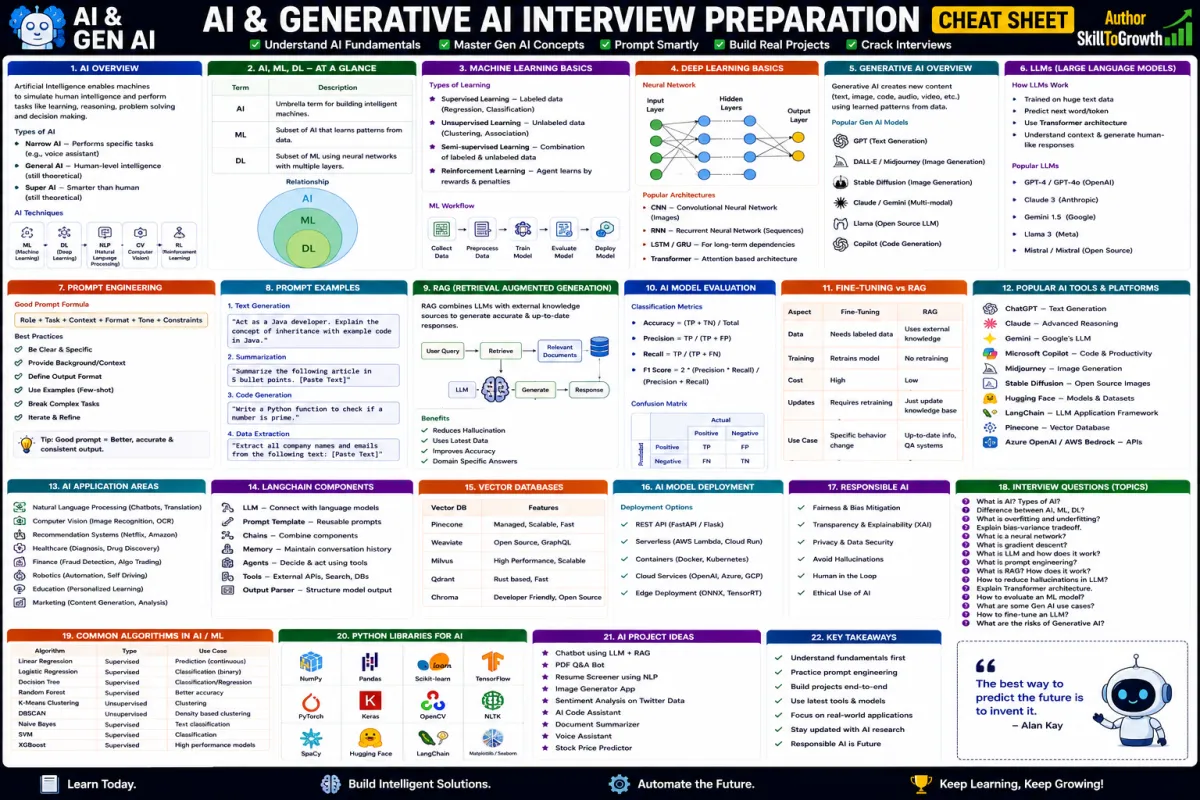
Prompt Engineering: Writing Effective AI Prompts, Prompting Techniques, Templates, Optimization & AI Safety
Prompt Engineering: A Complete Guide to Writing Effective AI Prompts, Prompting Techniques, Templates, Optimization & AI Safety
SkilltoGrowth Expert
Published on July 26, 2026Artificial Intelligence has transformed the way humans interact with computers. Instead of writing complex commands or programming instructions, users can now communicate with AI systems using natural language. Whether you're generating content, writing code, analysing data, creating marketing campaigns, designing applications, or automating business workflows, the quality of the AI's output largely depends on one critical factor—the prompt.
Imagine asking a software engineer to "build an app." The request is too broad. The engineer would immediately ask questions such as: What type of app? Who are the users? Which platform? What features should it include? Similarly, AI models require clear instructions to produce accurate, relevant, and useful responses. A vague prompt often produces vague results, while a well-structured prompt enables AI to deliver high-quality, context-aware outputs.
This process of designing effective instructions for AI models is known as Prompt Engineering. It combines communication, problem-solving, and domain knowledge to guide AI systems toward the desired outcome. Prompt engineering has become one of the most valuable skills in the era of Generative AI because it improves productivity without requiring changes to the underlying AI model.
Prompt engineering is no longer limited to AI researchers. Software developers, product managers, content creators, marketers, designers, business analysts, educators, and enterprise organisations all use prompt engineering to increase efficiency and automate complex tasks. As AI becomes deeply integrated into software applications and business workflows, understanding how to write effective prompts has become an essential professional skill.
In this chapter, you'll learn what prompt engineering is, understand the principles of effective prompt writing, explore zero-shot, one-shot, and few-shot prompting, understand chain-of-thought prompting, discover reusable prompt templates, learn prompt optimisation techniques, and explore prompt injection attacks along with AI safety best practices.
Why Prompt Engineering Is Important
AI models generate responses based on the instructions they receive.
Poor instructions often produce incomplete, inaccurate, or irrelevant outputs.
Well-designed prompts improve the quality, consistency, and usefulness of AI-generated results.
Benefits of Prompt Engineering
🔸 Improves AI response quality
🔸 Produces more accurate results
🔸 Reduces ambiguity
🔸 Saves time and effort
🔸 Supports business automation
🔸 Increases productivity
Professional AI applications rely heavily on carefully designed prompts.
Understanding the Prompt Engineering Workflow
Every interaction with an AI model follows a structured process.
User Defines Goal
        │
        ▼
Write Prompt
        │
        ▼
AI Processes Instructions
        │
        ▼
Generates Response
        │
        ▼
Review & Improve Prompt
Prompt engineering is an iterative process where prompts are refined until the desired outcome is achieved.
What Is Prompt Engineering?
Prompt Engineering is the process of designing, structuring, and refining instructions that guide an Artificial Intelligence model toward producing accurate, relevant, and useful responses.
A prompt may contain:
🔸 Instructions
🔸 Context
🔸 Examples
🔸 Constraints
🔸 Desired output format
🔸 Expected tone
Rather than relying on trial and error, prompt engineering provides a systematic approach to communicating with AI systems.
It focuses on asking better questions instead of simply asking more questions.
Components of an Effective Prompt
High-quality prompts usually contain several key elements.
Core Components
🔸 Objective
🔸 Context
🔸 Task description
🔸 Constraints
🔸 Desired format
🔸 Expected audience
Providing these details helps AI understand exactly what is expected.
Prompt Writing Best Practices
Writing effective prompts is similar to writing clear project requirements.
The clearer the instructions, the better the results.
Recommended Practices
🔸 Clearly define the objective
🔸 Provide sufficient context
🔸 Be specific rather than general
🔸 State the desired output format
🔸 Mention constraints or limitations
🔸 Specify the target audience
🔸 Break complex tasks into smaller steps
🔸 Review and refine prompts based on results
Following these practices significantly improves response quality.
Common Characteristics of Good Prompts
Professional prompts are generally:
🔸 Clear
🔸 Specific
🔸 Context-rich
🔸 Goal-oriented
🔸 Structured
🔸 Easy to understand
These characteristics reduce ambiguity and improve consistency.
Understanding Zero-Shot Prompting
Zero-shot prompting means asking the AI to perform a task without providing any examples.
The model relies entirely on its existing knowledge and the instructions contained in the prompt.
This is the simplest prompting technique.
When to Use Zero-Shot Prompting
Zero-shot prompting is suitable when:
🔸 The task is straightforward
🔸 General knowledge is sufficient
🔸 No specialised format is required
🔸 Quick responses are needed
It works well for many everyday AI interactions.
Understanding One-Shot Prompting
One-shot prompting provides the AI with a single example before asking it to perform a similar task.
The example demonstrates the expected style, structure, or behaviour.
The AI then uses that example as guidance for generating new responses.
Benefits of One-Shot Prompting
🔸 Improves output consistency
🔸 Clarifies expectations
🔸 Reduces ambiguity
🔸 Produces more structured responses
One-shot prompting is useful when output formatting matters.
Understanding Few-Shot Prompting
Few-shot prompting extends the same idea by providing multiple examples.
Instead of learning from one example, the AI observes several patterns before generating a response.
This approach often produces more accurate and consistent results for specialised tasks.
When Few-Shot Prompting Is Useful
Examples include:
🔸 Classification tasks
🔸 Data extraction
🔸 Customer support
🔸 Content formatting
🔸 Sentiment analysis
🔸 Business workflows
Enterprise AI systems frequently use few-shot prompting to improve reliability.
Zero-Shot vs One-Shot vs Few-Shot Prompting
Each prompting strategy has different strengths.
| Zero-Shot | One-Shot | Few-Shot |
|---|---|---|
| No examples | One example | Multiple examples |
| Fastest approach | Moderate guidance | Strongest guidance |
| Best for simple tasks | Better consistency | Highest accuracy for structured tasks |
| Minimal prompt length | Slightly longer prompts | More detailed prompts |
| General-purpose usage | Formatting guidance | Complex enterprise workflows |
Selecting the appropriate approach depends on task complexity and consistency requirements.
Understanding Chain-of-Thought Prompting
Some problems require reasoning rather than simply retrieving information.
Chain-of-Thought (CoT) Prompting encourages the AI to reason through a problem step by step before producing a final answer.
Rather than jumping directly to a conclusion, the model processes intermediate reasoning internally.
This technique is especially useful for complex analytical tasks.
Applications of Chain-of-Thought Prompting
Examples include:
🔸 Mathematical reasoning
🔸 Logical analysis
🔸 Business decision support
🔸 Multi-step planning
🔸 Software architecture
🔸 Technical troubleshooting
It helps AI handle tasks that involve multiple reasoning steps.
Note: Modern AI models often perform internal reasoning automatically. In many cases, it is more effective to ask for a well-explained answer or structured reasoning rather than explicitly requesting the model's internal thought process.
Prompt Templates
A prompt template is a reusable prompt structure designed for repeated tasks.
Instead of writing prompts from scratch every time, developers create templates containing fixed instructions with placeholders for changing information.
Templates improve consistency, speed, and scalability.
Benefits of Prompt Templates
🔸 Faster prompt creation
🔸 Consistent AI responses
🔸 Easier automation
🔸 Improved productivity
🔸 Simplified maintenance
Prompt templates are widely used in AI-powered business applications.
Prompt Optimization
The first prompt rarely produces the perfect response.
Prompt optimization is the process of improving prompts through continuous refinement.
Developers analyse AI responses, identify weaknesses, and modify prompts to improve accuracy, clarity, and relevance.
Prompt optimisation is an iterative process rather than a one-time activity.
Common Optimization Techniques
Professional prompt engineers often:
🔸 Add more context
🔸 Clarify objectives
🔸 Remove ambiguity
🔸 Simplify instructions
🔸 Specify output formats
🔸 Add constraints
🔸 Refine wording
Small improvements often produce significantly better AI responses.
Understanding Prompt Injection
As AI systems become integrated into enterprise applications, security becomes increasingly important.
Prompt Injection is an attack where a user attempts to manipulate an AI system by providing malicious or misleading instructions that override the application's intended behaviour.
For example, an attacker might try to persuade an AI assistant to ignore previous instructions, reveal confidential information, or perform actions outside its intended scope.
Prompt injection is one of the major security challenges in Generative AI applications.
Examples of Prompt Injection Risks
Prompt injection may attempt to:
🔸 Ignore previous instructions
🔸 Reveal confidential information
🔸 Bypass security policies
🔸 Manipulate AI behaviour
🔸 Produce harmful outputs
🔸 Mislead automated systems
Understanding these risks is essential when building AI-powered applications.
AI Safety Best Practices
Developers should design AI systems with security and safety in mind.
Recommended Practices
🔸 Validate user input
🔸 Separate system instructions from user input
🔸 Limit AI permissions
🔸 Protect confidential information
🔸 Apply content moderation where appropriate
🔸 Monitor AI interactions
🔸 Regularly review prompts
🔸 Keep security policies updated
Security should be considered throughout the AI development lifecycle.
Prompt Engineering Workflow in Enterprise Applications
Professional AI systems often follow a structured prompt lifecycle.
Define Business Goal
         │
         ▼
Create Prompt Template
         │
         ▼
Provide Context
         │
         ▼
AI Generates Response
         │
         ▼
Evaluate Output
         │
         ▼
Optimize Prompt
         │
         ▼
Deploy in Production
This iterative workflow ensures that prompts remain effective as business requirements evolve.
Best Practices for Prompt Engineering
Enterprise AI applications rely on consistent prompting strategies.
Recommended Practices
🔸 Define a clear objective
🔸 Provide relevant context
🔸 Use structured prompts
🔸 Choose the appropriate prompting technique
🔸 Optimise prompts through testing
🔸 Maintain reusable prompt templates
🔸 Apply AI safety controls
🔸 Continuously monitor prompt performance
🔸 Document successful prompts
🔸 Update prompts as requirements evolve
Following these practices improves both AI performance and user experience.
Common Mistakes Beginners Make
Many new AI users assume that any prompt will produce excellent results.
Common Mistakes
🔸 Writing vague prompts
🔸 Providing insufficient context
🔸 Asking multiple unrelated questions together
🔸 Ignoring output formatting
🔸 Expecting perfect responses on the first attempt
🔸 Failing to optimise prompts
🔸 Overlooking prompt security
🔸 Exposing sensitive information to AI systems
Avoiding these mistakes leads to more effective and secure AI interactions.
Chapter Summary
In this chapter, you learned how Prompt Engineering enables users to communicate effectively with AI systems. You explored the principles of writing clear and structured prompts, understood the differences between zero-shot, one-shot, and few-shot prompting, and discovered how chain-of-thought prompting can improve performance on complex reasoning tasks. You also learned the value of reusable prompt templates, explored techniques for prompt optimisation, and examined prompt injection attacks along with essential AI safety best practices for building secure and reliable AI-powered applications.
Prompt Engineering Interview Questions
Prompt engineering has become a common topic in AI, Generative AI, and LLM interviews.
Frequently Asked Questions
🔸 What is prompt engineering?
🔸 Why is prompt engineering important?
🔸 What are the characteristics of an effective prompt?
🔸 What is zero-shot prompting?
🔸 What is one-shot prompting?
🔸 What is few-shot prompting?
🔸 How does chain-of-thought prompting improve AI performance?
🔸 What is a prompt template?
🔸 What is prompt optimisation?
🔸 What is prompt injection?
🔸 How can prompt injection attacks be prevented?
🔸 What are the best practices for designing enterprise AI prompts?
Being able to explain these concepts demonstrates a strong understanding of modern AI interaction, Large Language Models, and enterprise AI application development.
Real-World Development Scenario
Imagine a multinational customer support company building an AI-powered virtual assistant that handles millions of customer enquiries each month. Instead of allowing every user request to interact directly with the AI model, the engineering team creates carefully designed prompt templates containing business rules, customer service guidelines, and response formatting instructions. Simple enquiries use zero-shot prompting, while specialised support workflows use few-shot prompting with carefully selected examples to maintain consistent responses. Developers continuously optimise prompts based on customer feedback and monitor AI behaviour to improve accuracy. To protect sensitive business information, user input is validated, system instructions are isolated from user prompts, and safeguards are implemented to defend against prompt injection attacks. By combining structured prompting techniques with strong AI safety practices, the company delivers reliable, secure, and high-quality AI support at enterprise scale.