What is Generative AI? Generative Artificial Intelligence, Large Language Models, Applications & Future Trends
What is Generative AI? Complete Guide to Generative Artificial Intelligence, Large Language Models, Applications & Future Trends
SkilltoGrowth Expert
Published on July 19, 2026Generative Artificial Intelligence, commonly known as Generative AI (GenAI), has become one of the most revolutionary technologies of the modern era. Unlike traditional Artificial Intelligence systems that analyze existing data or make predictions, Generative AI has the remarkable ability to create entirely new content. It can write articles, generate software code, design images, compose music, produce videos, summarize documents, answer complex questions, and even assist in scientific research.
In recent years, Generative AI has transformed how individuals, businesses, and developers work. Students use it to learn new concepts, marketers create advertising campaigns, software engineers generate code, designers create artwork, doctors summarize patient reports, and businesses automate customer support. Applications such as ChatGPT, Google Gemini, Claude, GitHub Copilot, Midjourney, and image generation models have demonstrated how AI can become a creative partner rather than simply a prediction engine.
Imagine you're building an e-commerce website. Instead of manually writing product descriptions for thousands of products, a Generative AI model can automatically generate SEO-friendly titles, descriptions, FAQs, marketing content, and social media posts in seconds. Similarly, customer support chatbots can provide intelligent responses, developers can generate boilerplate code, and content creators can produce blogs, videos, and presentations much faster than traditional methods.
Generative AI is powered by advanced Deep Learning models trained on enormous amounts of text, images, audio, video, and code. These models learn patterns, language structures, relationships, and contextual information from training data, enabling them to generate content that often appears natural and human-like.
As organizations increasingly integrate Generative AI into their products and workflows, understanding its concepts, capabilities, limitations, and practical applications has become an essential skill for software developers, data professionals, business leaders, and technology enthusiasts.
In this chapter, you'll learn what Generative AI is, how it works, understand Large Language Models (LLMs), explore different types of Generative AI, discover popular tools, examine real-world applications, understand its advantages and limitations, and learn why Generative AI is shaping the future of software development and digital innovation.
Why Learn Generative AI?
Generative AI is rapidly becoming a core technology across industries.
Learning it today opens opportunities in software development, automation, content creation, research, and enterprise solutions.
Benefits of Learning Generative AI
🔸 High industry demand
🔸 Increased productivity
🔸 Faster software development
🔸 Automation of repetitive tasks
🔸 Better problem-solving
🔸 Future-ready technical skills
Generative AI has become one of the most valuable skills in modern technology.
What is Generative AI?
Generative AI is a branch of Artificial Intelligence that creates new content instead of simply analyzing existing information.
Unlike traditional AI systems that classify, predict, or detect patterns, Generative AI produces original outputs based on the knowledge it has learned during training.
These outputs may include text, images, videos, audio, software code, presentations, documents, and more.
Types of Content Generated
🔸 Articles
🔸 Images
🔸 Videos
🔸 Music
🔸 Source code
🔸 Emails
🔸 Reports
🔸 Business documents
Generative AI assists humans by accelerating creative and analytical tasks.
How Generative AI Works
Generative AI models are trained using massive datasets collected from books, websites, research papers, software repositories, images, videos, and other publicly available or licensed sources.
During training, these models learn language structures, relationships, patterns, grammar, visual features, and contextual information.
When a user provides a prompt, the model predicts the most appropriate output based on its learned knowledge.
Basic Workflow
🔸 Collect training data
🔸 Train Deep Learning models
🔸 Learn patterns and relationships
🔸 Receive user prompt
🔸 Generate new content
🔸 Refine output
Although the process appears simple to users, it involves billions of mathematical calculations behind the scenes.
Large Language Models (LLMs)
Most text-based Generative AI systems are powered by Large Language Models (LLMs).
An LLM is a Deep Learning model trained on enormous amounts of text data.
It understands context, predicts words, answers questions, summarizes documents, translates languages, and generates human-like responses.
LLMs form the foundation of modern conversational AI.
LLM Capabilities
🔸 Question answering
🔸 Content writing
🔸 Code generation
🔸 Translation
🔸 Summarization
🔸 Text classification
Modern AI assistants rely heavily on LLMs.
Role of Deep Learning
Deep Learning enables Generative AI to understand complex relationships in text, images, audio, and video.
Advanced neural network architectures allow AI models to generate highly realistic content.
Without Deep Learning, modern Generative AI would not exist.
Types of Generative AI
Generative AI can create many different forms of content.
Each category focuses on a different type of output.
Text Generation
Text generation models produce written content.
Examples
🔸 Blogs
🔸 Emails
🔸 Documentation
🔸 Product descriptions
🔸 Research summaries
🔸 Marketing content
Text generation is one of the most widely used Generative AI applications.
Image Generation
Image generation models create new digital artwork or realistic images based on text prompts.
Applications
🔸 Graphic design
🔸 Product mockups
🔸 Advertising
🔸 Social media graphics
🔸 Concept art
Image generation has transformed digital design workflows.
Code Generation
Generative AI assists software developers by generating code, explaining algorithms, debugging errors, and suggesting improvements.
Applications
🔸 REST APIs
🔸 SQL queries
🔸 Unit tests
🔸 Documentation
🔸 Code refactoring
Code generation significantly improves developer productivity.
Audio Generation
AI can generate speech, music, and sound effects.
Applications
🔸 Voice assistants
🔸 Audiobooks
🔸 Podcasts
🔸 Music composition
🔸 Voice cloning
Audio generation continues to evolve rapidly.
Video Generation
Video generation models create animations and videos from text or images.
Applications
🔸 Educational videos
🔸 Marketing content
🔸 Product demonstrations
🔸 Animated presentations
🔸 Storytelling
Video generation is becoming increasingly important in digital media.
Popular Generative AI Tools
Many organizations provide powerful Generative AI platforms.
Examples
🔸 ChatGPT
🔸 Google Gemini
🔸 Claude
🔸 GitHub Copilot
🔸 Midjourney
🔸 Stable Diffusion
🔸 DALL·E
Each tool specializes in different types of AI-generated content.
Generative AI vs Traditional AI
Although both belong to Artificial Intelligence, they serve different purposes.
| Feature | Traditional AI | Generative AI |
|---|---|---|
| Primary Purpose | Analyze and predict | Create new content |
| Output | Classification, prediction | Text, images, code, videos |
| Learning Focus | Pattern recognition | Pattern generation |
| Examples | Fraud detection, spam filters | Chatbots, AI writers, image generators |
| Creativity | Limited | High |
Understanding this distinction is essential when selecting AI solutions.
Applications of Generative AI
Generative AI is transforming nearly every industry.
Software Development
Applications
🔸 Code generation
🔸 Documentation
🔸 API creation
🔸 Debugging assistance
🔸 Test generation
Developers increasingly use AI as a coding assistant.
Content Creation
Applications
🔸 Blog writing
🔸 Social media posts
🔸 Product descriptions
🔸 Marketing campaigns
🔸 SEO content
Generative AI accelerates digital content production.
Healthcare
Applications
🔸 Medical report summarization
🔸 Clinical documentation
🔸 Drug research assistance
🔸 Patient communication
AI helps healthcare professionals reduce administrative workload.
Education
Applications
🔸 Personalized learning
🔸 AI tutors
🔸 Assignment explanations
🔸 Quiz generation
🔸 Course creation
Education platforms increasingly integrate Generative AI.
Business Automation
Applications
🔸 Customer support
🔸 Report generation
🔸 Email drafting
🔸 Meeting summaries
🔸 Workflow automation
Businesses use AI to improve operational efficiency.
Advantages of Generative AI
Generative AI provides significant value across industries.
Key Benefits
🔸 Increased productivity
🔸 Faster content creation
🔸 Improved creativity
🔸 Cost reduction
🔸 Personalized experiences
🔸 Scalable automation
These advantages explain its rapid global adoption.
Limitations of Generative AI
Despite its capabilities, Generative AI has important limitations.
Common Challenges
🔸 Incorrect information (hallucinations)
🔸 Bias in training data
🔸 Privacy concerns
🔸 Intellectual property considerations
🔸 Limited real-time knowledge in some models
🔸 Dependence on prompt quality
Responsible use requires human review and verification.
Future of Generative AI
Generative AI continues to evolve rapidly.
Future systems are expected to become more capable, multimodal, collaborative, and deeply integrated into business workflows.
Emerging Trends
🔸 AI Agents
🔸 Autonomous workflows
🔸 Multimodal AI
🔸 Enterprise AI assistants
🔸 Scientific research support
🔸 Personalized AI companions
Generative AI will play a central role in the next generation of intelligent software.
Common Mistakes Beginners Make
Many newcomers misunderstand how Generative AI works.
Common Mistakes
🔸 Assuming AI always provides correct answers
🔸 Confusing Generative AI with Machine Learning
🔸 Writing vague prompts
🔸 Skipping fact verification
🔸 Ignoring ethical considerations
Critical thinking remains essential when using AI-generated content.
Best Practices for Using Generative AI
Professional developers and businesses use Generative AI responsibly.
Recommended Practices
🔸 Write clear prompts
🔸 Verify generated information
🔸 Protect sensitive data
🔸 Use AI as an assistant, not a replacement
🔸 Continuously refine prompts
🔸 Stay updated with new AI capabilities
Responsible usage leads to more reliable and valuable outcomes.
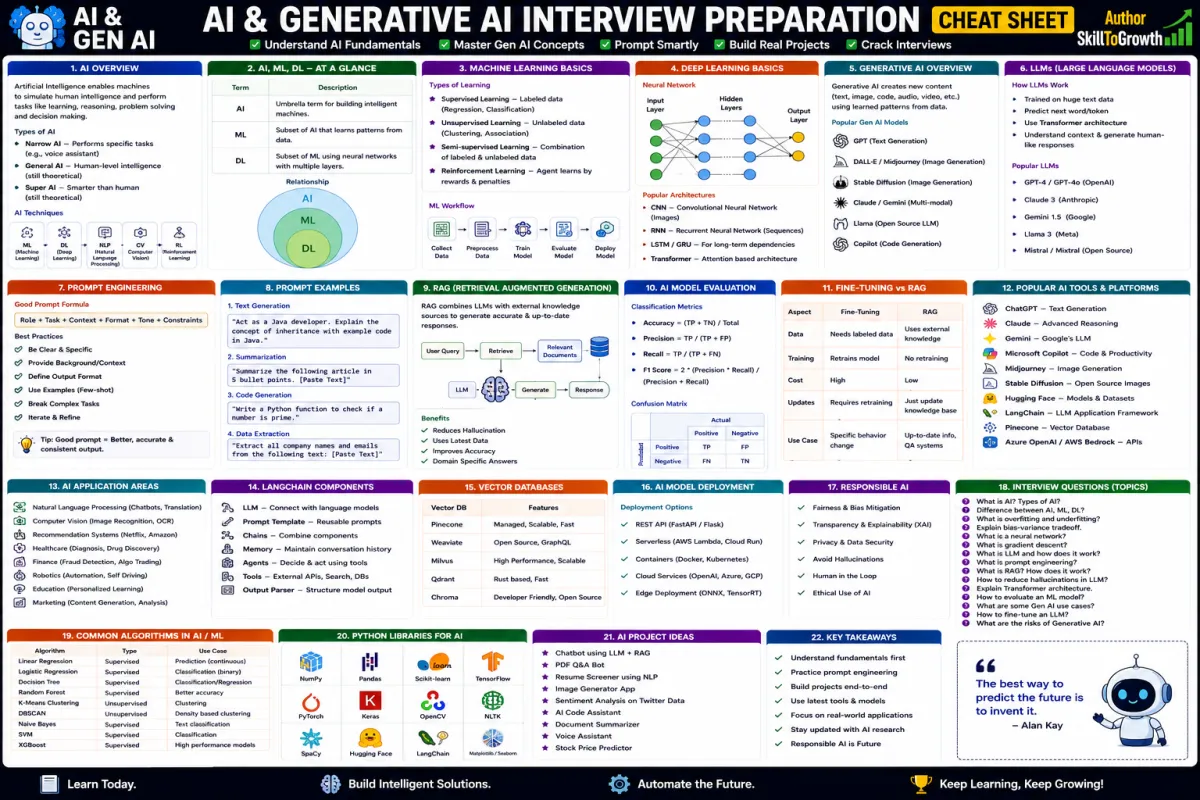
Generative AI Interview Questions
Generative AI has become a common topic in technical interviews and AI-related job roles.
Frequently Asked Questions
🔸 What is Generative AI?
🔸 How does Generative AI differ from traditional AI?
🔸 What is a Large Language Model (LLM)?
🔸 What types of content can Generative AI create?
🔸 Explain prompt engineering.
🔸 What are the applications of Generative AI?
🔸 What are the limitations of Generative AI?
🔸 How is Deep Learning related to Generative AI?
🔸 What industries use Generative AI?
🔸 How can businesses benefit from Generative AI?
Being able to answer these questions with practical examples demonstrates a strong understanding of modern AI technologies.
Real-World Development Scenario
Imagine you're developing an AI-powered blogging platform. Instead of manually writing every article, the system allows users to enter a topic, keywords, target audience, and writing style. A Large Language Model generates SEO-friendly blog posts, while an image generation model creates featured images. Another AI service summarizes lengthy articles for social media, and a code generation assistant helps developers build new platform features. By integrating multiple Generative AI models through APIs, the platform dramatically reduces content creation time while improving productivity and user experience.